Patient story
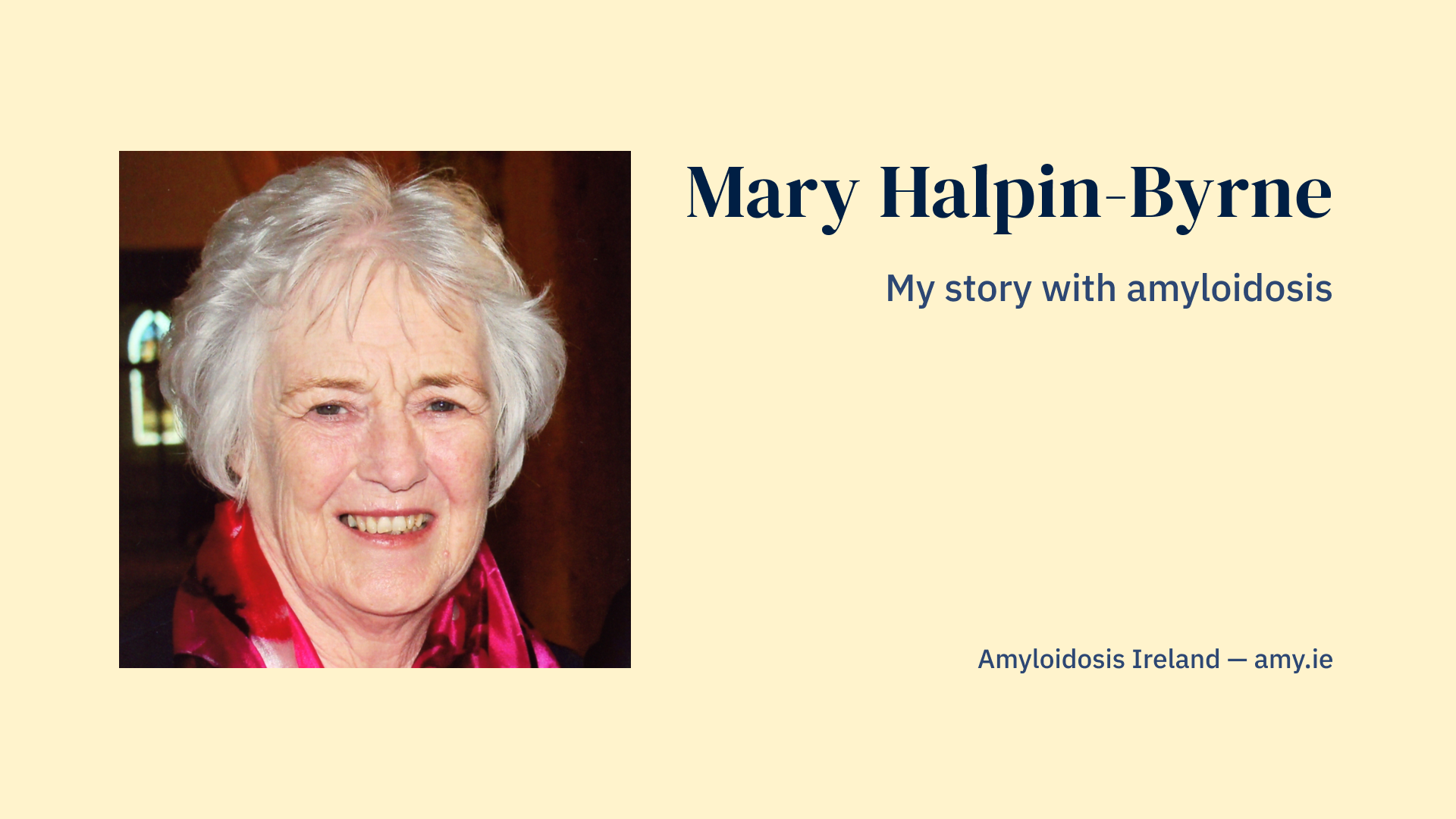
Patient story: Mary Halpin-Byrne
It’s been over twenty-five years ago now since I heard the term Familial Amyloid Polyneuropathy (FAP).
More familiarly known now as hATTR—hereditary transthyretin amyloidosis, this complex, distressing and difficult condition became part of my family history when my mother was diagnosed with it in the early 1990s.
Her journey to diagnosis was relatively quick, helped, no doubt, by the advanced nature of her symptoms when she presented to a neurologist for the first time.
My mother was given two years to live, with the underlying threat that she could die at any time. They were stark words in a stark time, when there was nothing available to treat her.
Her doctor did not consider liver transplantation, which we were given to understand was the only treatment available. We relied on conventional treatments, and later palliative care, for cardiac, neurological and gastrointestinal symptoms for the remaining twenty months of her life.
My mother had her wish to die at home and bore the burden of her illness with immense dignity. May her gentle soul rest in peace.
The hereditary nature of hATTR has now manifested itself, with several members of my immediate family affected by the Thr60Ala gene, or The Donegal Mutation, to give it the title that confirmed my mother’s diagnosis.
Whilst I do not carry the faulty gene, hereditary amyloidosis is now part of my own, and my family’s, history. I am writing these few words as a testament to my personal journey.
Following my mother’s diagnosis, doctors mentioned that this was an inherited disease and that we should receive genetic counselling. To give a bit of context here, our dad had died suddenly just two years before mam and then our family was plunged into her illness and diagnosis.
After mam died, life was a bit grey. With the competing priorities of work and a young family, I was not immediately inclined to seek genetic counselling.
However, I always mentioned amyloidosis when giving a family history to medical professionals and noticed that it was not raising any red flags. A few doctors nodded their heads and expressed little knowledge of the condition, while others tried to reassure me I had nothing to worry about.
It was my current GP who, on hearing my history, referred me to a Genetic Neurologist who made a referral for genetic testing. After some time waiting, the initial referral was rejected because they felt there was not enough evidence about my mother’s condition to warrant an appointment.
Up to this point, I was somewhat sanguine about the whole thing. My next appointment with the consultant was imminent. I had been in two minds whether to attend as there was very little happening, but rejection of the referral cut deep.
I felt it was making a liar out of me and was very disrespectful to my late mother, so I attended the appointment, fully intending to let my feelings be known.
As can happen in life, I had a stroke of luck that day. A very nice young female doctor empathised with my feelings and agreed to look for the result of a blood test.
The test was mentioned in my mother’s medical notes as having been completed, but there was no corresponding documentation of the result on her file. They had completed the test in the very hospital I attended for the consultation.
It was a long shot, and we both knew it, but the fact she was willing to try was good enough on the day.
It was my husband who got the phone call a week later. His phone number was on file as my next of kin; for some reason, the hospital did not have my phone number—they’d found my mother’s test results!
It was a small white piece of paper, hardly the size of an envelope; an old-fashioned laboratory report hidden in the bowels of the medical archives. Here was the evidence that mam had tested positive for the Donegal Mutation.
The next referral for genetic testing was accepted, and they placed me on a waiting list again.
Meanwhile, things were happening in my family, with one sibling becoming symptomatic and starting their own journey to the National Amyloidosis Centre (NAC) at The Royal Free Hospital in London and a definitive diagnosis.
Following on from this, I followed up on the genetic testing appointment, was put on a standby list and given a named person who was dealing with the matter. When I informed them of the developments within my family, they agreed to test other family members.
Before this was completed, a second sibling attended the NAC and received a definitive diagnosis.
They tested the rest of us in October 2019, and we got results in January 2020. I do not carry the Thr60Ala mutation. My four siblings who do are all on their own journey, and their story is theirs to tell.
In memory of my mother, and to support my family members, I remain committed to raising awareness about hereditary amyloidosis and will endeavour, in so far as I can, to support anyone who might need a helping hand or a listening ear.
Thankfully, today the future is much brighter.
All credit to the dedication and commitment of the many men and women for their work and research on hereditary amyloidosis. All credit to the voices of patients and carers around the world who are always advocating for their fellow sufferers. There is now much hope and a sense of community for patients and their families.
Whilst there is no cure, the condition can be managed and its progression slowed down, or halted, thanks to groundbreaking new medications and advances in gene-silencing and gene-editing treatments. These offer such hope to patients and their families.
There is now a real possibility of a much-improved quality of life, with a reduction of symptoms and distress. It has to alleviate some of the pain and anguish for those like myself who watched helplessly as a relentless disease took our loved one from us far too early.
I have one final thought. Whilst hATTR is considered a rare disease, it is hereditary with an autosomal dominant dimension. This means there is a 50/50 chance of inheritance for children of affected people.
Since becoming involved in the ATTR Amyloidosis All Ireland Support Group, I have been struck not only by the number of immediate family members affected, but by the numbers of cousins and other relatives within an extended family network who are presenting with symptoms, if not a definitive diagnosis.
This makes the need to address outstanding issues of early diagnosis across to genetic testing and counselling and access to treatments all the more urgent to ensure that all patients and their families can have the hopeful future that is now available for them
In memory of all who were not so lucky, this is the least we can do.